
Safe
For networks with delicate devices: one device at a time.
- 20packets/s per device
- 2web requests/s per device
- 1concurrent connections per device
Vulnerability management platform
Complete visibility across networks, servers and endpoints. Priorities based on real-world exploitation. Concrete, measurable, documented remediation. All deployed in your own infrastructure.
Request a demoExplore the platform
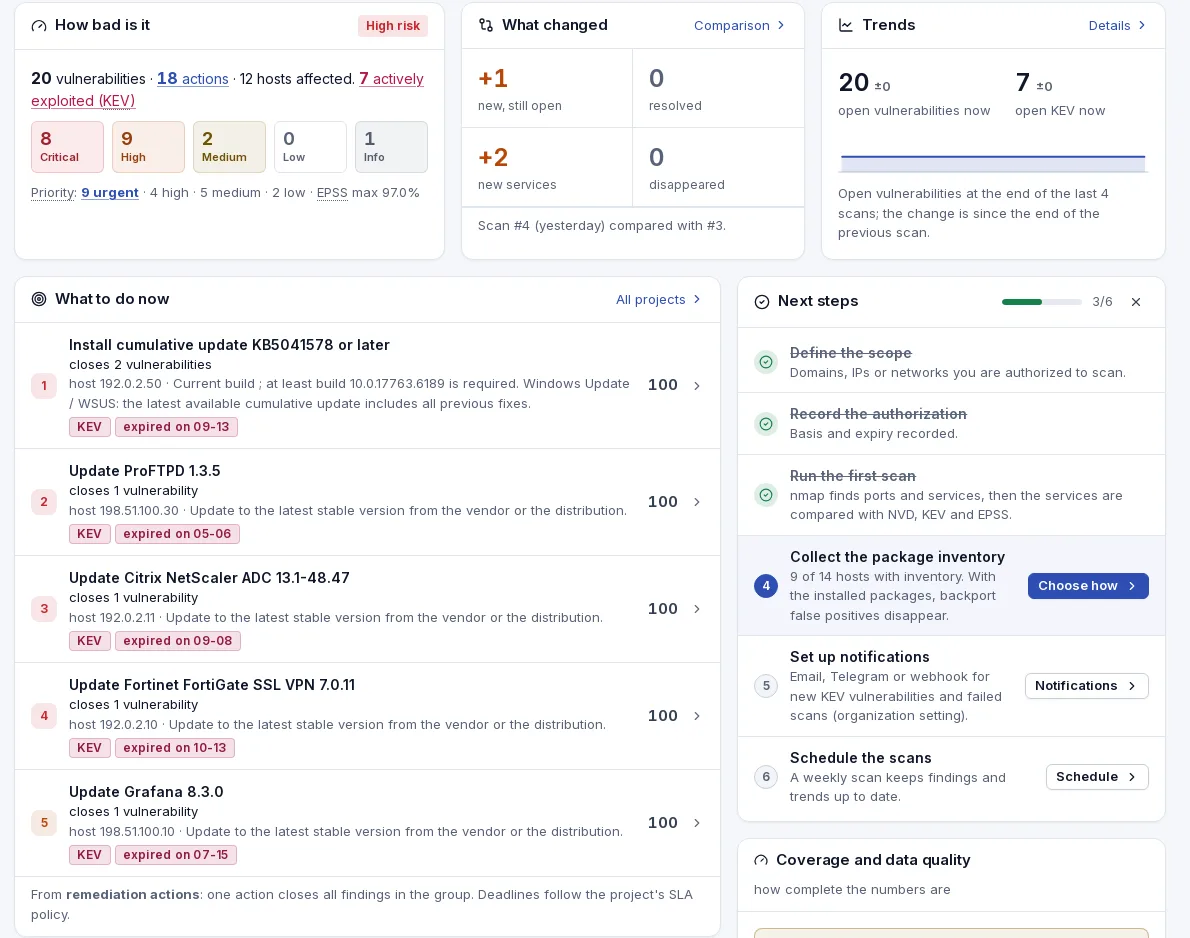
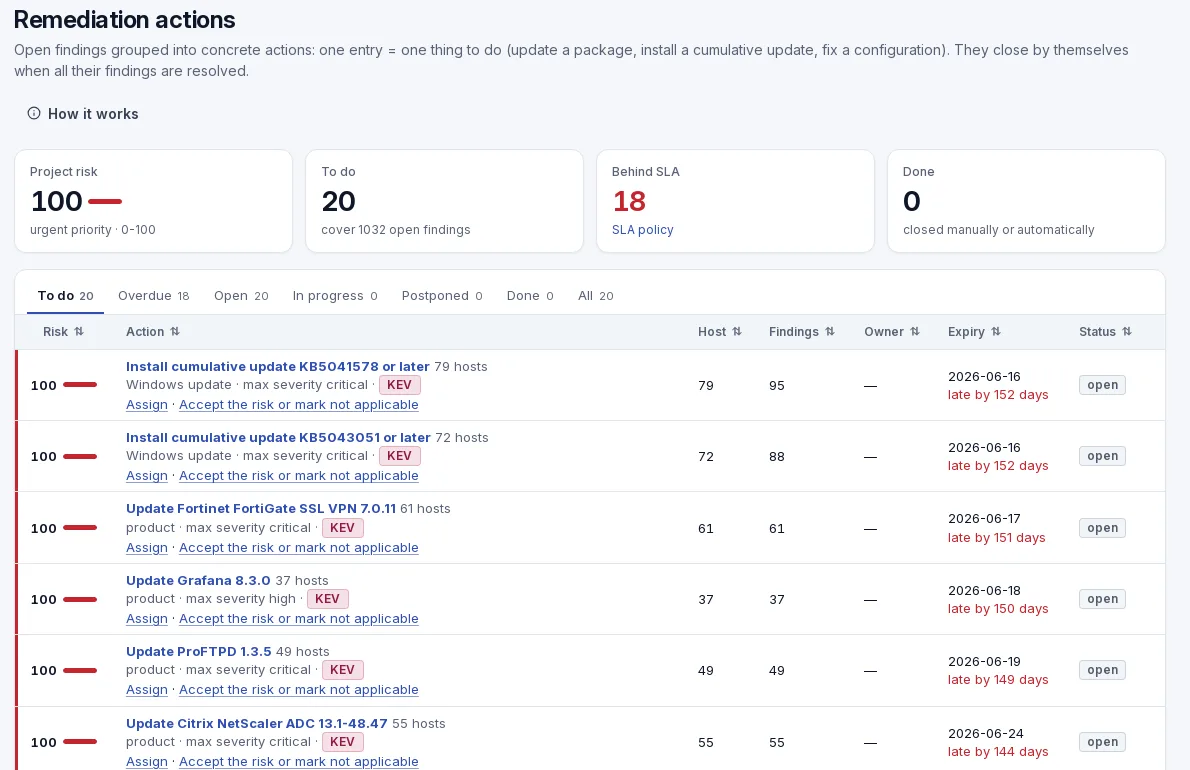
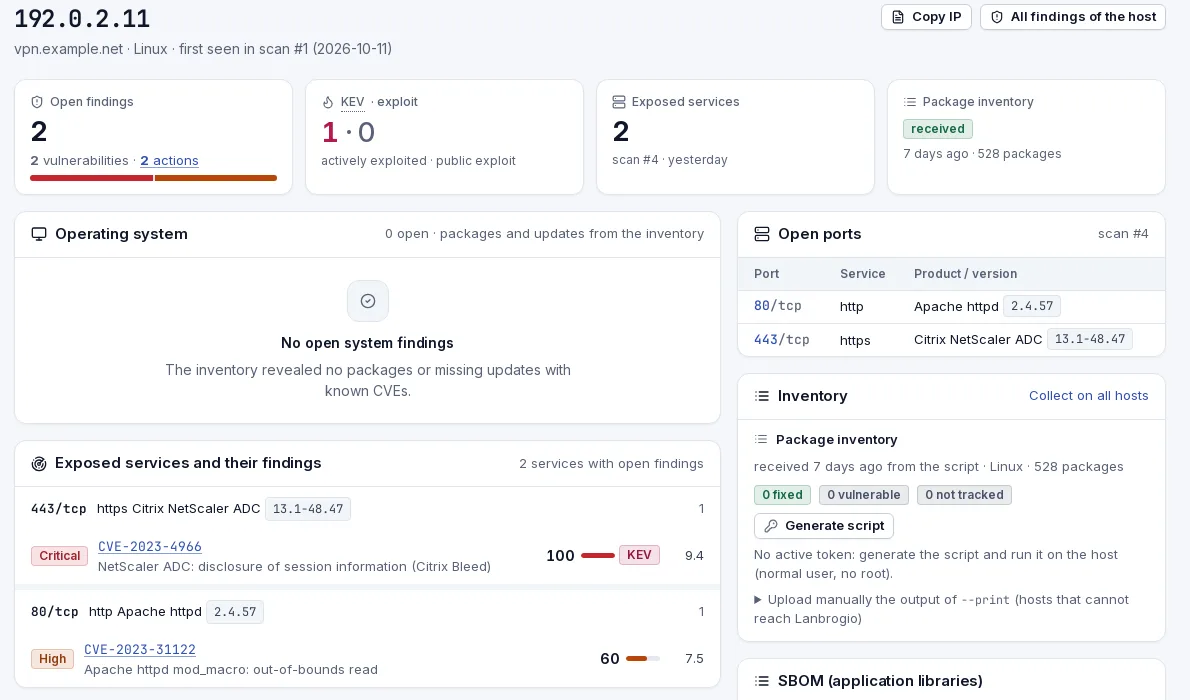
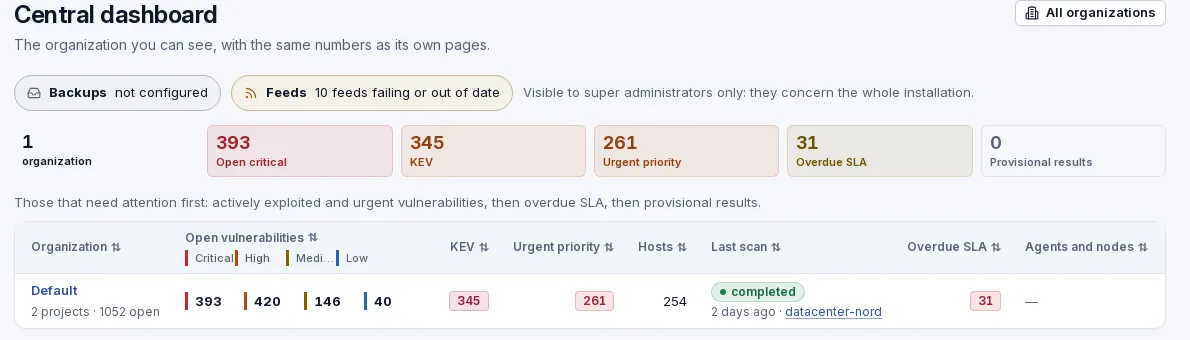
Figures from the demo project included in the platform.
Each stage feeds the next: data never leaves your perimeter and every step stays on record.
Hosts, ports and services on the network; packages and updates installed on servers and endpoints.
Checked against NVD, distribution, Microsoft and vendor advisories, with backport verification.
A 0–100 risk based on known exploitation (KEV), likelihood (EPSS), exposure and severity.
Grouped actions, assigned and with SLA deadlines, closed automatically when the scan confirms the fix.
Executive and technical reports, trends over time, a verifiable activity log.
Intelligence updated automatically from
A thousand CVEs are not a work plan. Lanbrogio groups them into concrete actions, such as a cumulative update or a product version, ranked by risk and with the number of affected hosts. Each action closes every vulnerability it fixes.
An interface designed for people who need to decide quickly: every page answers one question.
Printers, cameras and industrial devices react badly to heavy traffic. Lanbrogio limits the load on every single device, not only the total: the protection stays the same when there are only a few hosts.
For networks with delicate devices: one device at a time.
The default: a balance between speed and caution.
For networks of modern servers and workstations.
For large, robust networks and short maintenance windows.
The Custom profile keeps hand-set values for special cases.
A central server, scanner nodes at remote sites and agents on your systems. Nodes and agents only open outbound HTTPS connections: no inbound ports to open at your sites.
Ports and services, non-intrusive checks aimed at the right service, TLS and SSH checks, four speed levels with per-device limits, scheduled scans.
System packages, running kernel, Windows updates and installed applications, checked against vendor advisories.
NVD, CISA KEV, EPSS, the CVE List, OSV, MSRC, CSAF and end-of-life data, with CVSS scores even before NVD publishes them.
A single indicator combining known exploitation, likelihood, exposure and asset criticality.
Assignment, SLA deadlines, justified exceptions with an end date, links to tickets.
Central dashboard, roles per organization and project, LDAP or OIDC sign-in, two-factor authentication and passkeys.
Notifications by email, Telegram and webhook, a REST API with tokens, import of results from other scanners.
Per-host evaluation, separate work queues and fleet updates only when something actually changed.
Executive and technical reports in PDF and HTML, accessible and printable, in all five interface languages.
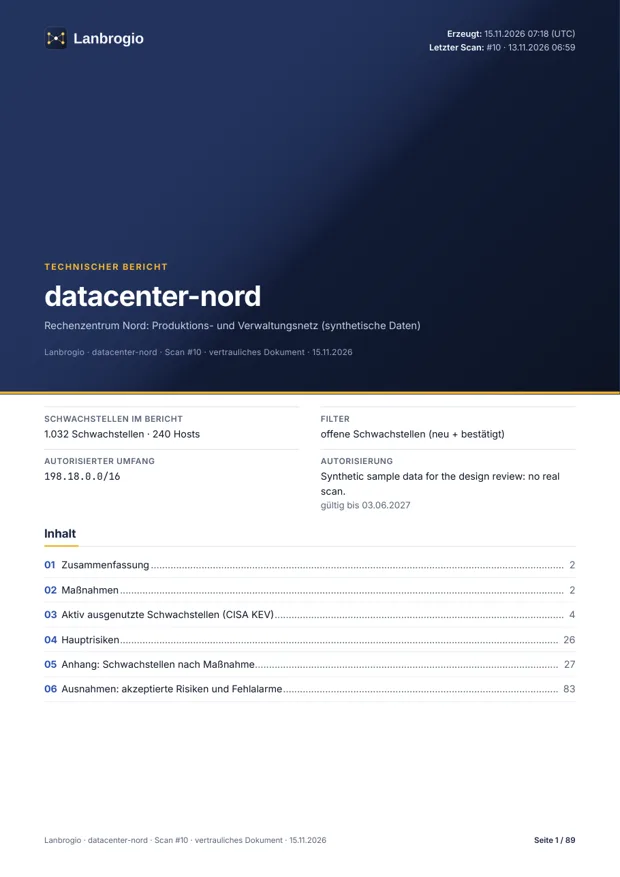
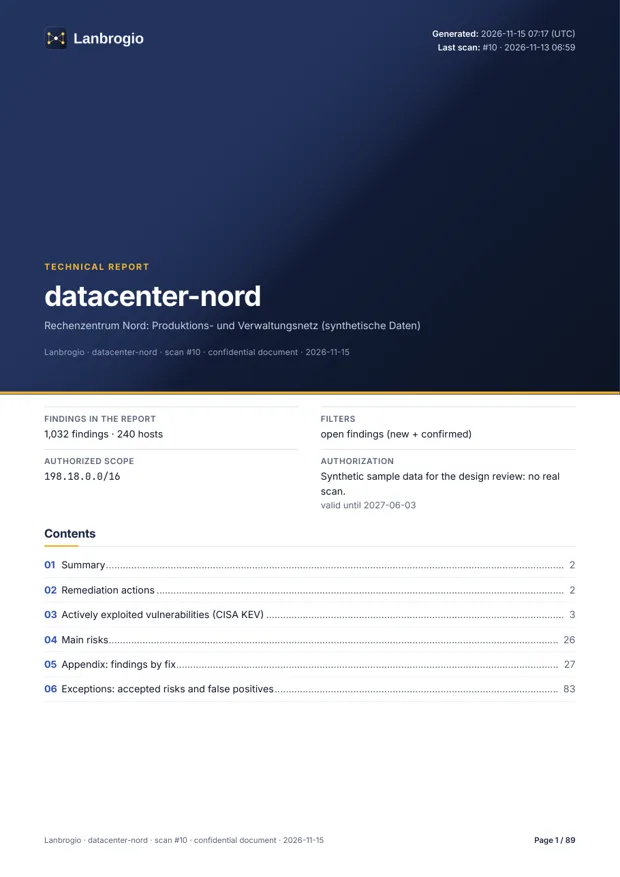
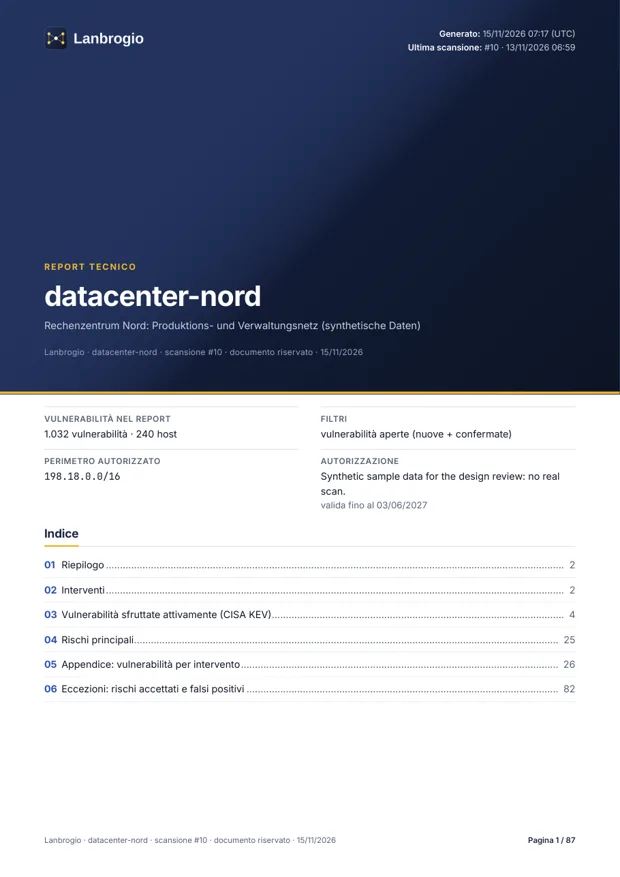
A tool that knows every weakness of your network must be the best-protected system in your infrastructure.
Installed on your own server with Docker. The only outbound connections download the public feeds.
Every operation is recorded in a hash chain; the application can neither modify nor delete it.
Separate database roles for the application, scans and backups; the process that handles network answers holds no keys.
Encrypted nightly backups with verified restores; agents and nodes only accept signed packages.
On your server. Lanbrogio is installed in your infrastructure with Docker; outbound connections download the public vulnerability feeds.
A Linux server (amd64 or arm64) with Docker. Roughly 2 vCPU, 4 GB RAM and 20 GB disk for up to about 250 hosts; 4 vCPU, 8 GB and 50 GB for about 2,000 hosts.
Speed levels limit the traffic to every single device and the Safe level scans one device at a time. Printer ports never receive data.
No. Network scanning works without agents. For the software inventory you can use the agent for Linux and Windows, a script with nothing to install, or an SSH connection.
With scan nodes: containers installed at the site that connect to the server over outbound HTTPS only. No port to open towards the site.
Interface and reports in Italian, English, French, Spanish and German.
A walkthrough on demo data and support for a trial in your own environment.